What Do You Get From The Programme
Enhanced Interpersonal Communications
The DISC Personality Profiling System can help you resolve potential interpersonal problems by providing insights into an individual’s preferred communication style. By learning about an individual’s preferred style, you can adapt their style with yours and enhance communications effectiveness by minimizing miscommunications. Communications among students and educators/teachers, between students and educators will be enhanced through the understanding, appreciation and adaptation of the DISC communication styles.
Creating Effective Teamwork
Strong and effective teamwork are formed on the basis of mutual trust as team members grow to understand and appreciate each other’s personal inclinations and contributions to the group. The DISC Personality Profiling System™ will help students and educators to understand why others behave the way they do, which they may not instinctively know. Hence, this enhances interpersonal understanding and reduces the misreading of comments and actions.
Encouraging Personal Growth & Personnel Management
It’s a no-brainer that people will excel in roles that match their skills and natural inclinations. The DISC Personality Profiling Style System™ is able to reveal personal, management and leadership qualities, detail-oriented and organisational skills, natural sales ability, personal service and team-player tendencies. The DISC profile highlights the greatest motivation and weakness of each personality style, as well as the ideal environment in which the individual thrives in. By obtaining insights on individual differences and preferences, educators can better manage, motivate and develop their students effectively.
Boosting Stress Management Skill
The DISC Personality Profiling System™ identifies individuals who are experiencing transitions in life or stress that are resulted by vague expectations, unrealistic goals, transitioning changes and poor stress management techniques. Early identification and management of stress are of paramount importance in our modern day life. Therefore, the DISC profile provides a simple but powerful tool for detection and potential remedy for stress. Better stress management results in higher individual, group and organisational efficiency.
Facilitating Career Planning (Students)
Certain personality styles suit certain occupations or job roles. In discovering this, the DISC Personality Profiling System™ will facilitate effective career planning by helping students discover aspects of their individual style, passion and motivation which are tailor-made for certain jobs and occupational demands. A successful job match allows an individual to be productive and creative at his or her workplace, while gaining better job satisfaction as a whole!
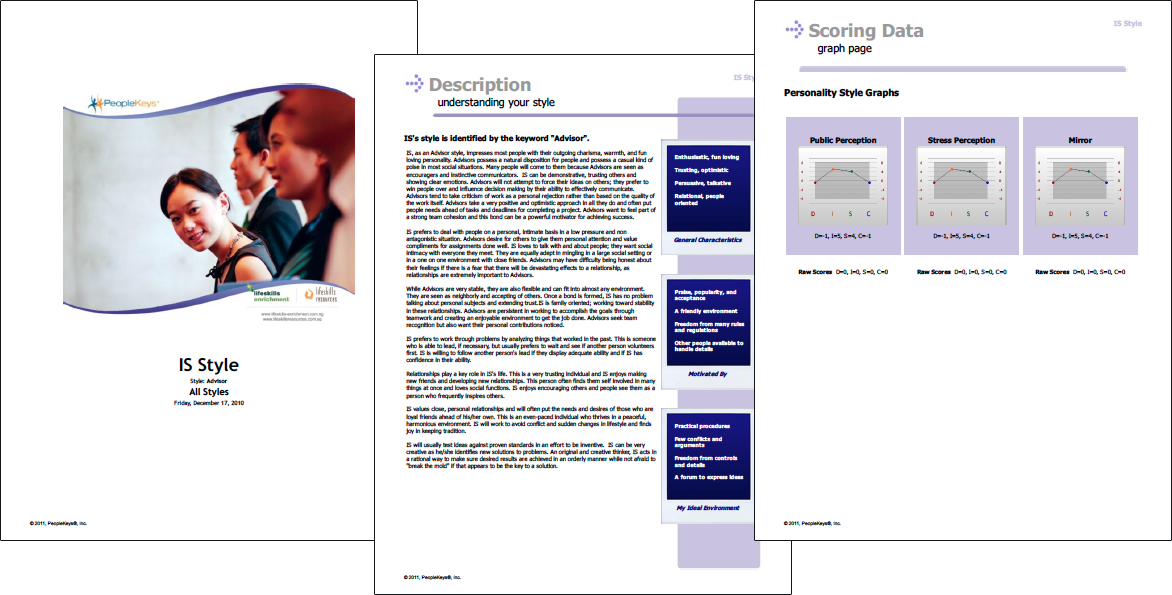
What you will find helpful in the report:
- Introduction – to your personality report
- Description – understanding your personality style
- Motivational Characteristics – of your behavioral style
- Historical Characters – who share your style
- Communication – DO’s and DONT’s
- Communication – worksheet
- Graph page – based on your results
- Action Plan – to improve interpersonal skills