About Programme
What is it about?
The LearningKeys™ model is designed based on the theory that all learning engagements are different, depending on an individual’s personality, perception and cognition.
Under this programme, students will undergo individual self-assessments to identify their own Personality, Learning and Thinking Styles. Reflection exercises for participants will also be allocated in order to allow them to critically examine and evaluate their own preferred learning styles. Structured activities will also help to reinforce the uniqueness of the different learning preferences, providing handles which students can use in their learning, both inside and outside the classroom.
What You Get From The Programme
- Discover and be encouraged to leverage on their personal strengths
- Learn a practical process for unleashing their people and communication skills
- Gain insights on what motivates them
- Deepen their understanding of and appreciation for diversity and individual differences
- Learn proven strategies for adapting to new learning situations
Program Topics
Module 1: Personality (Communication and Motivation Preferences)
Student participants will use The DISC Personality System to identify their Personality Style. The DISC Personality System™ is the universal language of behaviour. DISC is a four-quadrant behavioural model based on the work of William Moulton Marston Ph.D. (1893 – 1947) that examines the behaviour of individuals in their environment or within a specific situation. Knowing the Personality Styles enables us to understand a person’s motivation, strengths and limitations.
Module 2: Perception (Learning Preferences)
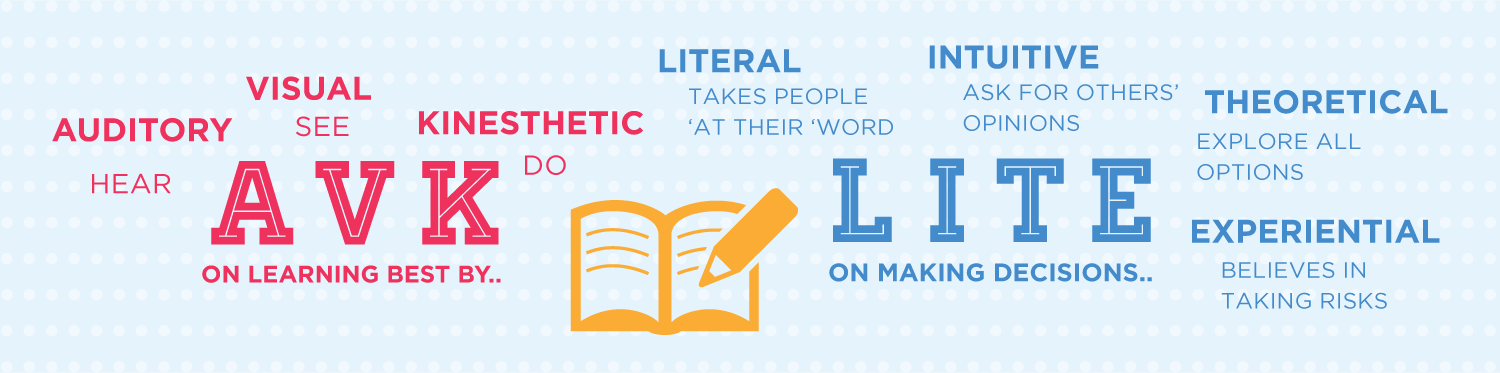
The Perceptual Learning Style assessment identifies an individual’s preferred channels of receiving and absorbing new information into the body. The instrument focuses upon the three sensory channels – ears (auditory), eyes (visual), and hands (kinesthetic/tactile). This system is commonly referred to as AVK (Audio Visual Kinesthetic). The AVK methodology has its origins in theories like Neuro-Linguistic Programming (NLP) and Multiple Intelligences.
Module 3: Cognition (Thinking Preferences)
The Cognitive Thinking Style assessment identifies an individual’s preferred pattern of cognitive processing in thinking once information enters the body through the sensory modalities. The LITE method identifies four main styles of cognitive processing – L (Literal), I (Intuitive), T (Theoretical), and E (Experiential). The Cognitive Thinking Style and LITE model is based upon a compendium of different works, models, and theories by different authors.
